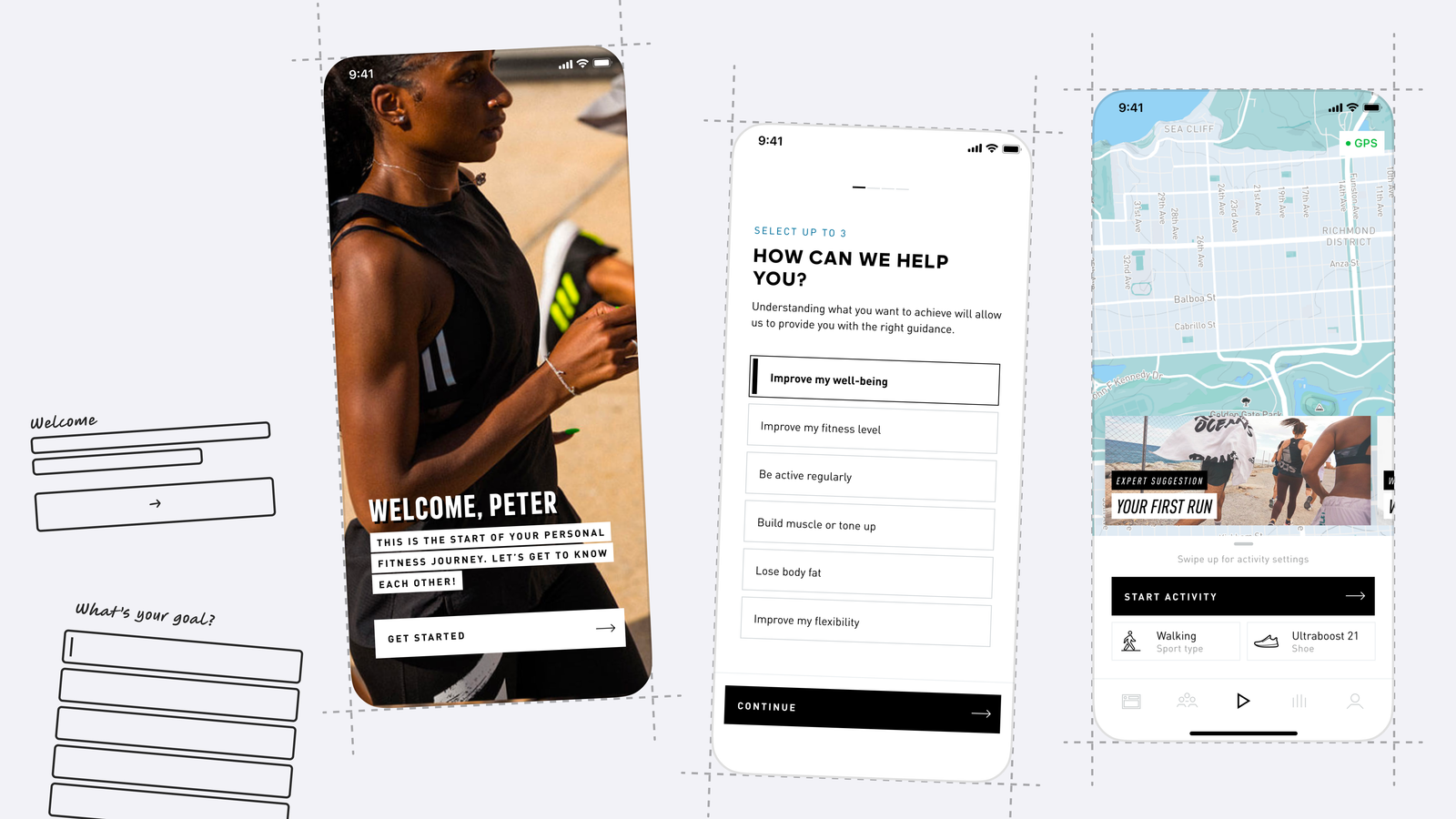

I redesigned the mandatory onboarding steps shared by adidas Running and adidas Training, combining two inconsistent flows into one. The first version tested reasonably well but had a hidden structural problem uncovered through user testing. Rebuilding the flow around the right question, not just better screens, fixed it.
Role: Product designer, working with a product manager and the Sport Science and User Research teams. I owned the flow design, the competitor research, and both rounds of user testing.
Overview
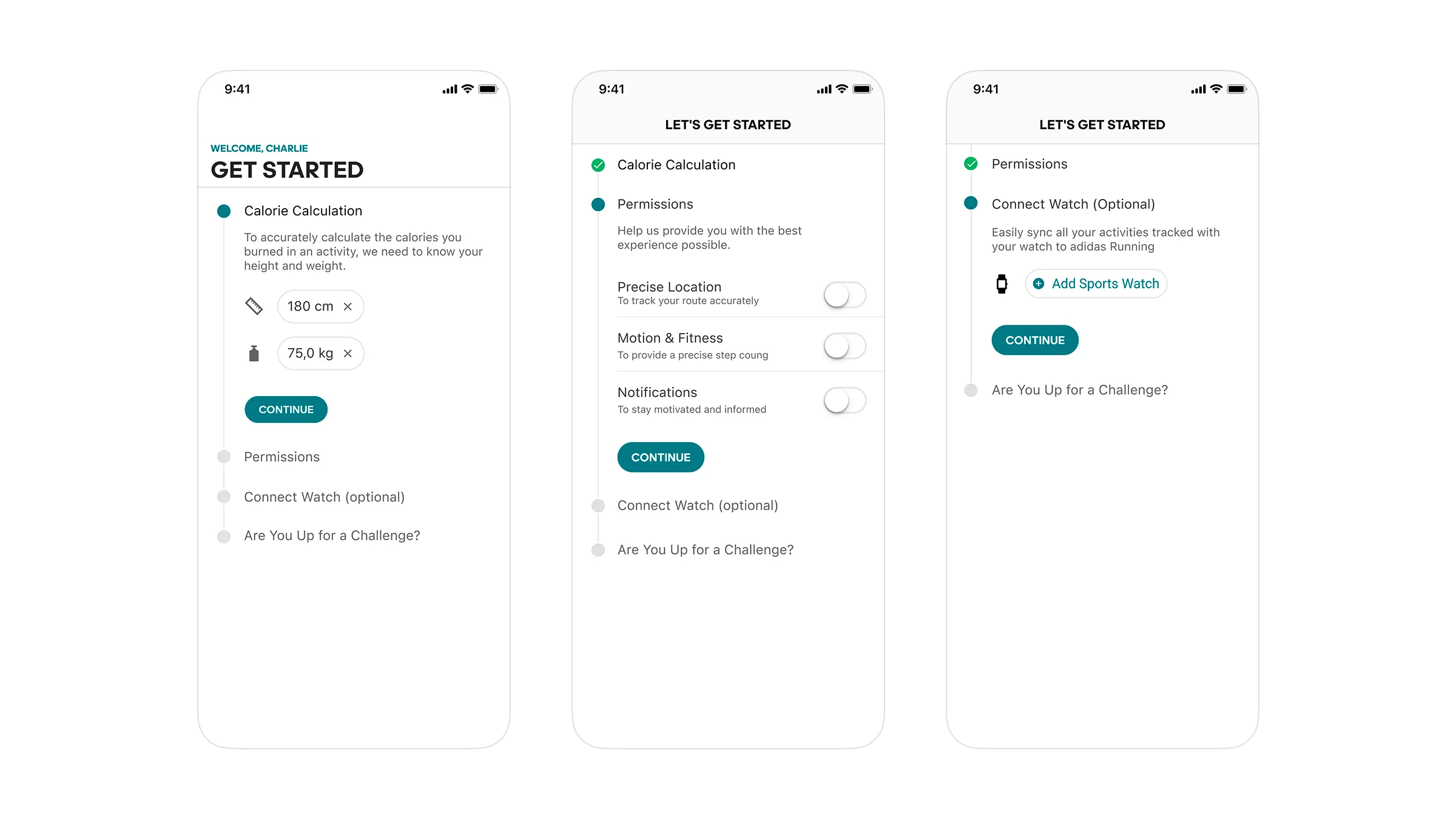
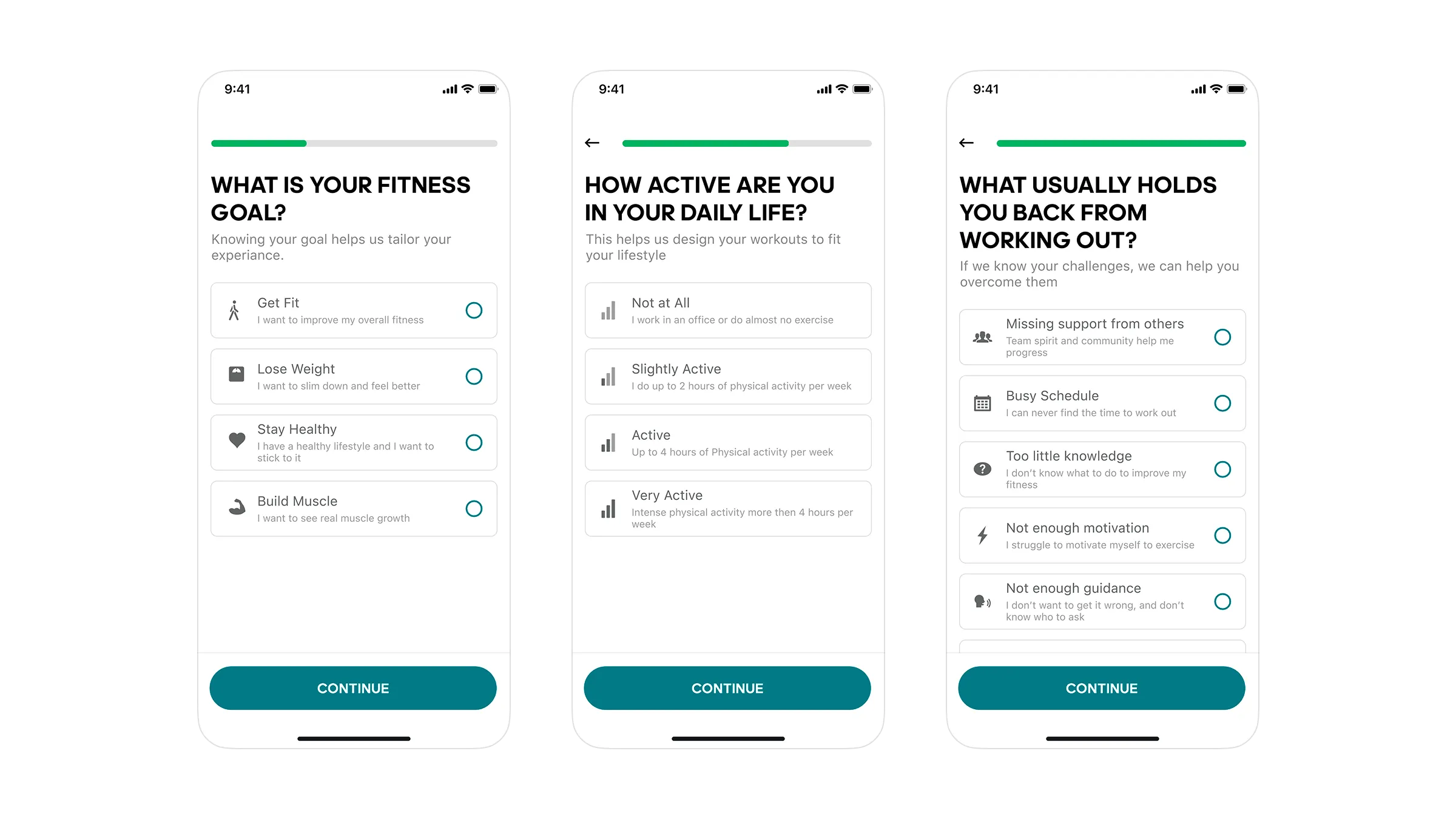
Both the adidas Running and adidas Training apps required a few steps after account creation before users could start their fitness journey. In Training, that meant three questions about fitness level, goals, and motivational blockers. In Running, it was more of a setup: weight, height, activity tracking permissions, and an optional smartwatch connection. The two flows had grown apart, and neither one was working as well as it should. My goal was to combine the best of both into a single onboarding that was informative and engaging from the very first steps, and to increase the rate of users going from registration to their first activity.
The problem
The two apps asked different questions for different reasons, and neither felt like it was collecting the right information to actually help someone get started. We wanted to use this part of the journey to gather only what was essential, so we could tailor the rest of onboarding to what a person was actually there for.
Preparation
Before drafting anything, I ran a competitor analysis and went back through past user research to see what we already knew.
Competitor analysis
Almost every fitness app I looked at asked some version of the same question early on: what are your goals, what's motivating you. A few went further with questions specific to their own focus area. Running that analysis gave me a much clearer sense of what users walk in already expecting from a sports app, not just what adidas had done before.
User research insights
The most useful thing sitting in our past research was that users expect to be asked about their fitness goals and challenges the moment they open a fitness app. Skip that, and they read it as the app not caring about their needs. That single insight became the foundation for the first draft, and it held up again later, showing up independently in both rounds of user testing.
First draft
Working closely with our Sport Science and User Research teams, I sketched and iterated quickly in Figma. The flow asked users about their current fitness level and their reason for using the app, then tailored the rest of onboarding to their answer.
I built a working prototype and ran a round of unmoderated user testing. Since the flow had four possible paths, we split participants into four groups using a screener question that mirrored the in-flow goal question, so every path got covered. We measured results against a set of requirements and an overall Quality Experience (QX) Score.
- Goal of the study
- Find out how users feel about the new onboarding journey
- Goal of user
- I want to be onboarded to the app and get ready for my fitness journey
Comfortable providing personal information
Target: Rating above 3.5 avg.
4.57
Comfortable accepting the legal terms
Target: Rating above 3.5 avg.
4.57
Satisfied with the fitness setup
Target: Rating above 3.5 avg.
4.57
Activate notifications
Target: 60% activate
64.29%
Activate marketing consent
Target: 50% activate
14.29%
Feel ready to use the app
Target: Rating above 3.5 avg.
4.57
Satisfied with the onboarding
Target: 70% state satisfied
93%
The flow met most of our requirements, but the overall QX Score fell short of what we expected. The opt-in rates for notifications and marketing missed their targets too, though with a sample this small those numbers need to be read with some caution.
A deeper look at the QX Score showed loyalty rated poorly, tied to 14% of participants saying they were still unsure about the app's value proposition after going through the flow. On top of that, we found a structural problem: about half of the participants who had picked a goal other than "improve my fitness" in the screener ended up choosing that option anyway once they were actually in the flow. Improving fitness turned out to be closer to a universal goal than a distinct one, and the other options we'd designed around it were really just supporting reasons underneath it. That meant the whole branching structure needed to change, not just individual screens.
Second draft
Instead of asking why someone was using the app, the new flow asked how we could help them, with answer options built around the goals we already saw users have. We added questions about what motivates them and what's currently holding them back, and a screen designed to build trust early by showing the app understood their situation.
A second round of user testing followed the same format.
- Goal of the study
- Find out how users feel about the new onboarding journey
- Goal of user
- I want to be onboarded to the app and get ready for my fitness journey
Activate notifications
Target: 60% opt in
66.67%
Activate emails
Target: 50% opt in
50%
Activate paid media marketing
Target: 50% opt in
50%
Satisfied with the onboarding questions
Target: Rating above 3.5 avg.
4.5
Feel ready to use the app
Target: Rating above 3.5 avg.
4.5
Satisfied with the onboarding
Target: Rating above 3.5 avg.
4.33
This flow met all of our requirements, and trust and loyalty both improved. Compared to the first version of the flow, we also saw a142% increase in what we called the adidas Credibility Lift*.
*In both usability tests, participants were asked to rate the relevance of adidas in supporting their fitness journey with content, both before and after going through the onboarding flow. The difference between their answers before and after is what we refer to as the adidas Credibility Lift.
Outcome
We hit our goal for the quarter: a validated onboarding flow with a measurable jump in trust, loyalty, and brand credibility over what shipped before. Implementation was planned for the following quarter, but company priorities shifted and the rollout was delayed before it reached users.
Looking back, I'd scope a smaller piece of this that could still be properly validated but shipped sooner. That way real improvements reach users earlier, instead of everything landing at once at the end.